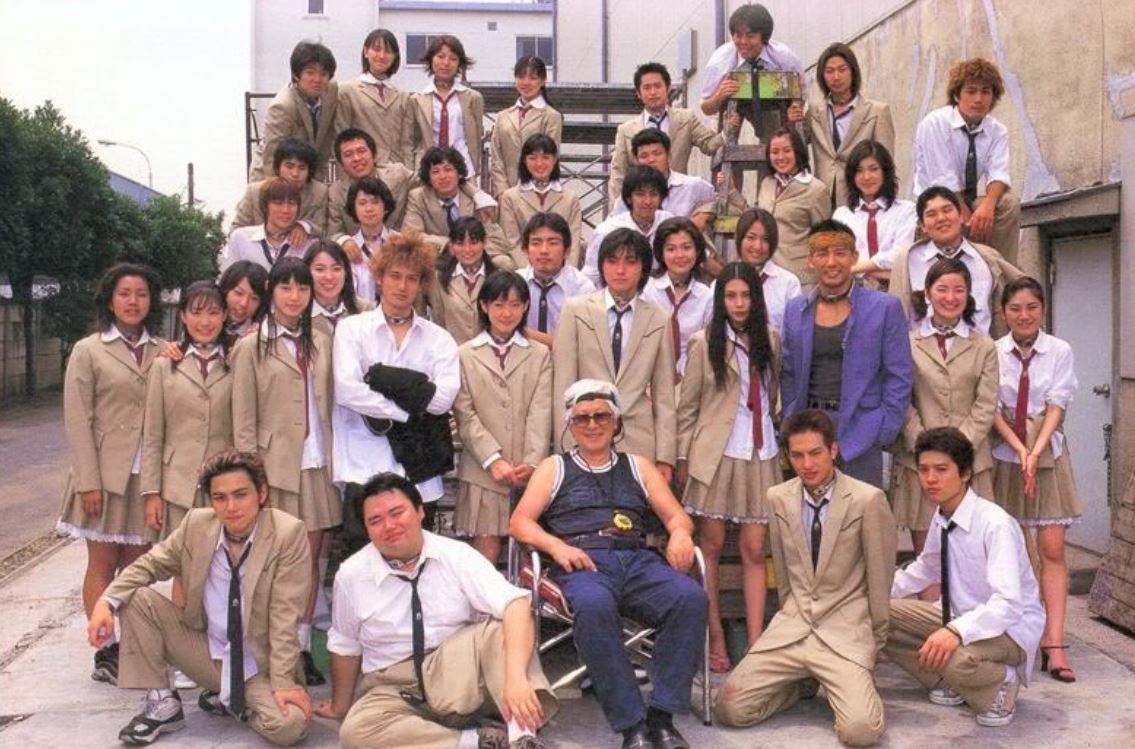
Battle Royale
A class of Japanese high school students are forced to participate in a government-mandated death game on a deserted island, where they must kill each other until only one remains
It’s hard to overstate the impact of Battle Royale. From its highly controversial launch in Japan in early 2001, to its much -hyped UK release 4 days after the 9/11 attacks, through to its afterlife as an era-defining computer game genre and film and television mainstay, the Battle Royale concept has become a touchstone for 21st century story telling. The set up is an all-timer: In the near future the young are damaged and angry. Adults live in fear. ‘Everything is twisted; there is no one to show us the way’ says Nanahara Shuya as his life collapses around him; his mother absent, his school in chaos and his father dead by suicide, all before he turns 17. This is, we are to understand, commonplace; a society literally falling apart, turning on itself, degraded and violent. There is only one answer: the Millennium Education Reform, or “BR Act”, through which each year a single class is selected, deposited on a remote island with explosive tracking collars and given a single weapon each. They are then instructed to fight to the death.
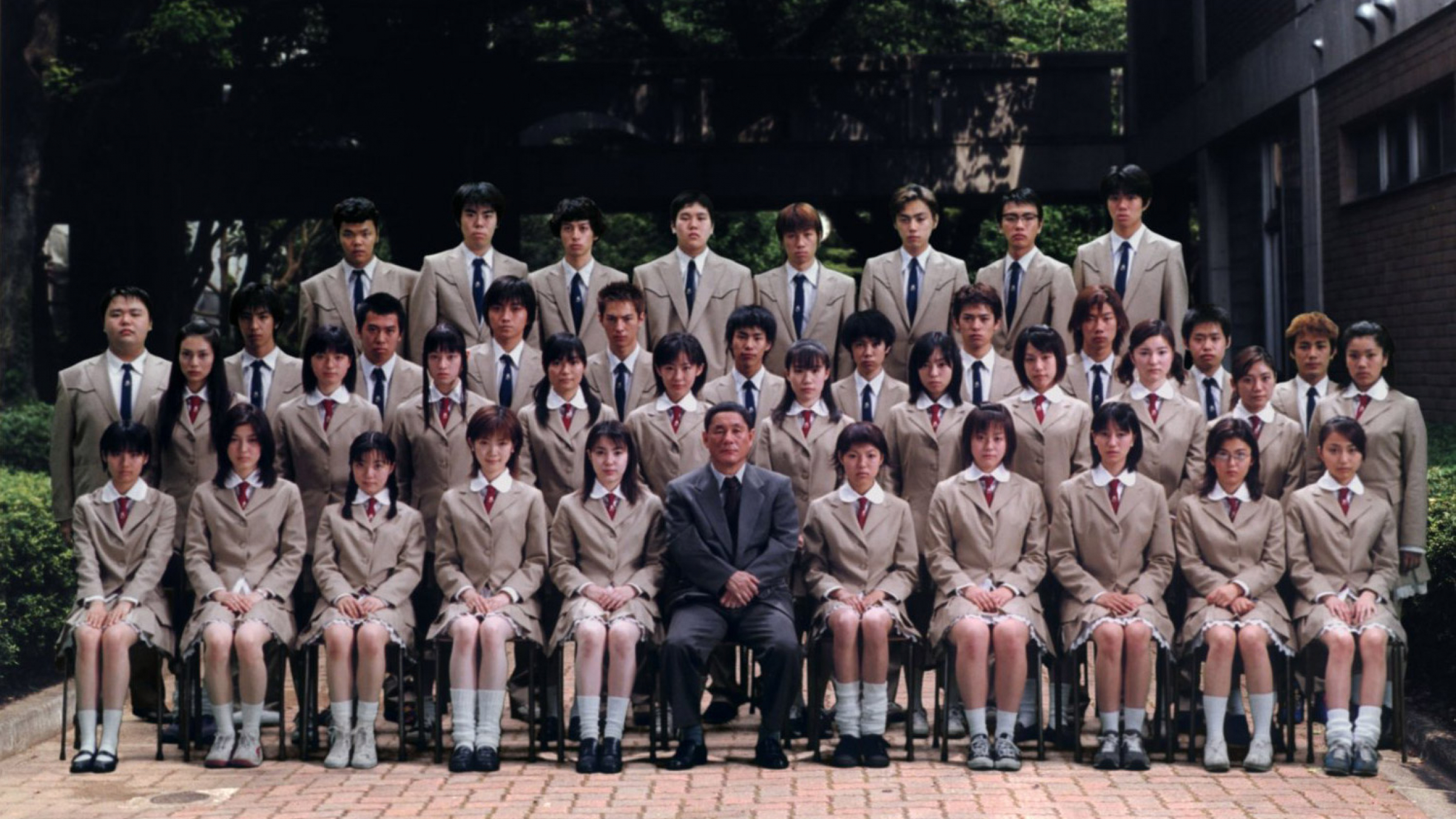
It arrests the imagination like nothing else: the extremity of the ordeal faced by the victim characters provides the ultimate dramatic test of emotional resolve and survival and, most importantly for the screen, it provides each of them with the opportunity to inflict spectacular acts of violence on each other. There has always been an audience for big screen ultraviolence both in Japan and abroad but there’s something so outlandishly sadistic about the Battle Royale setup that begs explanation: where did this come from? Why depict school children flamboyantly murdering each other? It has to mean something, surely??
One of the best explanations was written a few years after the film’s release by Andrea G Arai – I recommend you read the whole article in fact. In ‘Killing Kids’ she explains that the in-movie “BR Act” hews extremely closely to real world education reforms being debated in Japan at the turn of the millennium. Following decades of growth and prosperity a lengthy recession drove a dagger into the Japanese economy and its social institutions. The economic shock – unemployment, poverty, debt – rattled the confidence of the nation, and let old ghosts from the past back into the public psyche. Older Japanese, including Battle Royale’s director Fukasaku Kinji, felt that contemporary youth had lost the sense of belonging to the nation and to each other that was born out of earlier struggles. Arai describes contemporary authors who saw
‘a youth with no sense of belonging to the nation. They are consumers (shohisha), rather than citizens (kokumin)… Without the opportunity to experience the ‘moving feeling of individual sacrifice’ of battle for the nation, the young are doomed (and so by insinuation is the nation) to live out a life of irreparable psychic split (bunritsu) between the individual (ko) and the public (koe).’
Fukusaku, 70 at the time of Battle Royale’s release and director of 60 films in his career at that point, carried with him some horrific childhood experiences of war. As a 15 year old munitions worker he at one point had to hide under dead bodies and rubble to escape a bombing raid. Throughout his career he depicted various forms of violence, playing a pivotal role in the distinctive yakuza genre as well as contributing to landmark historical epics such as Battles Without Honour or Humanity. He saw the Battle Royale story as a fable (it had been a novel previously), and an opportunity to show that ‘the extremes of life and death experienced in a battle to the end suggest a way to recover the physical and moral bonds of society that seem to have come so unglued, but were available for his generation.’ This can be seen cinematically in the journey of the head-band wearing boy soldier Kawada. His character offers redemption, or perhaps deliverance for troubled youth, and a moral safe place within the carnage familiar from western war movies. The intergenerational dialogue about struggle and death is an important aspect of the film, and shouldn’t be diminished by the sometimes absurdist depiction of violence.
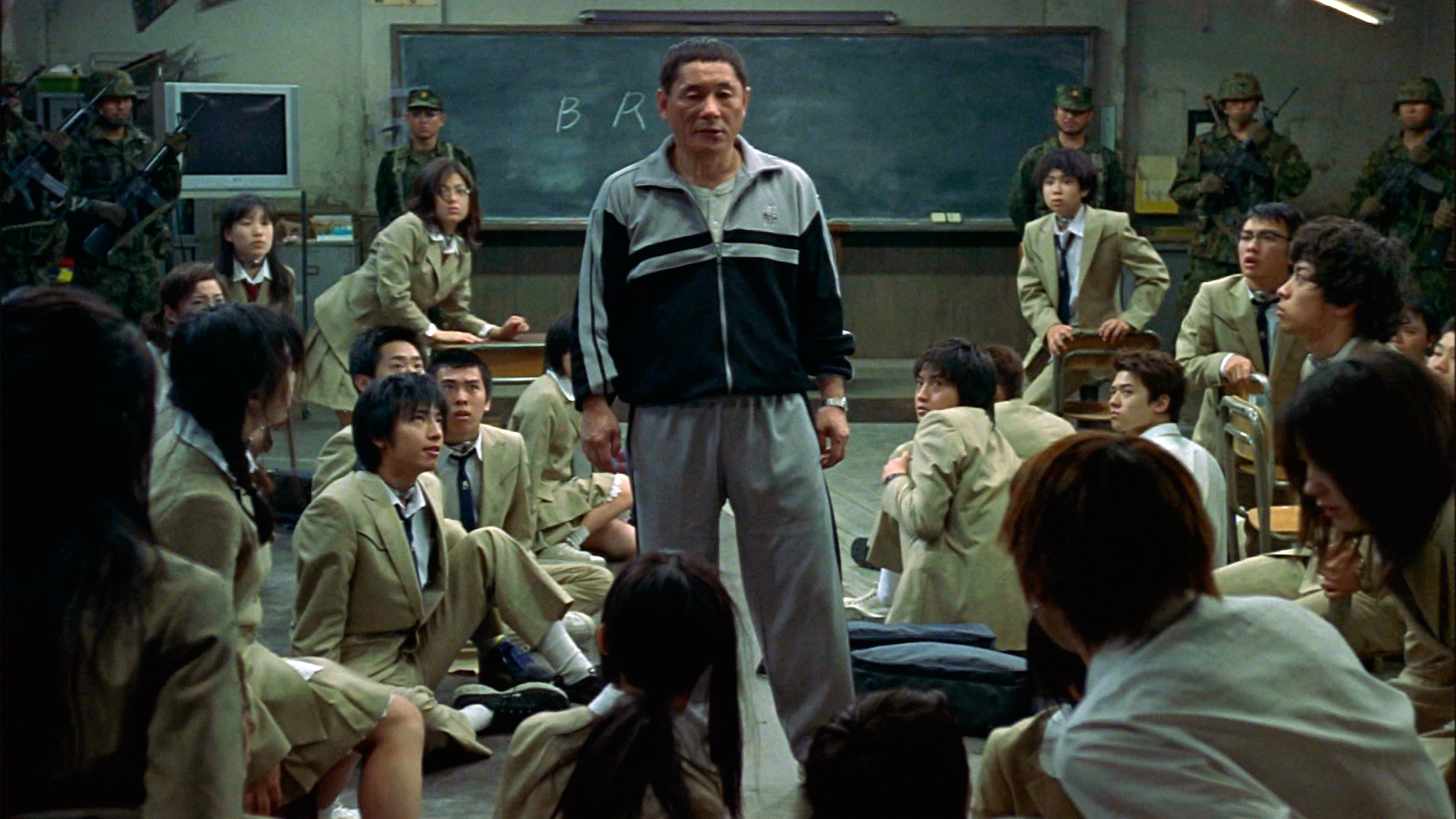
Because despite Fukusaku’s statements Battle Royale is never really a particularly serious kind of movie. Certainly it was never received as such by younger audiences who flocked to it in Japan and in the UK, the latter largely behind the ingenious (if problematic) marketing campaign of Tartan Films. In a western context Battle Royale plays out more as an allegory or malevolent satire, its mocking depictions of authoritarianism, and especially the way fascism reproduces itself via mass media, owe much to the sly sci-fi of Paul Verhoeven or Paul Glaser’s 1987 Running Man. Battle Royale revels in subverting the brutality of the state, especially the peculiar violence of the classroom. Arai confirms that Japanese youth (and many adults) had long felt that their educational system was needlessly competitive and martial. By the turn of the millennium,, with the future rewards of a booming economy all but removed, education seemed only to offer competition, abuse and loss. The film’s contrast of the kids’ humanity in the eye of state’s heedless violence is at odds with the high-minded propositions of the elder Fukasaku and his generation, without ever completely denying them. This tension is personified by sensei Takeshi, played inimitably by Beat Takeshi as both sadistic authority figure and damaged romantic; another emotionally stunted adult crushed and left behind by a failing society.
While the wider context of Battle Royale is fascinating we might risk overlooking the cinematic virtues of the film. Its relatively low budget is compensated by brilliantly choreographed action set pieces and committed performances from its young cast. The blood-letting is neither casual nor overly serious, confidently walking a fine line between shock and hilarity. You can take your pick of fun minor characters and sub plots to root for, and the sardonic presence of Takeshi lends his scenes an eerie, uncanny quality: I could be convinced of a psychological reading of the film with him as its main character, hallucinating the whole affair from a hospital bed? Maybe not, but there is so much film making skill on display, no subtext is ever too mad to be completely out of the question. It’s certainly a modern cult classic, telling both a gripping story and plausibly building a world without morality or sense, where the only justice is poetic, dispensed visually and metaphorically across the screen.