
J-Horror Halloween 2025
Japanese Film Club comes to Rich Mix Cinema for a 3 day J-Horror Halloween Special! We're kicking off on Friday one of the most notorious J-Horrors ever made, Takeshi Miike's Audition. On Saturday we keep the pace with Kiyoshi Kurosawa's masterpiece, Cure. Then on Sunday we're switching tempo with Shinichiro Ueda's genre bending zombie comedy, the cult classic One Cut Of The Dead.
Japanese Film Club invites you to our first ever annual J-Horror Halloween Special, at Rich Mix cinema in London. Join us in the heart of Shoreditch for 3 days of horror, bloodshed, and belly laughs.
We hit the ground running on Friday night with a film I’ve had multiple people tell me they refuse to re-watch; the seminal, and unbearable, AUDITION. Saturday’s film, Kiyoshi Kurosawa’s breakout CURE, is a transcendental exploration of the darker side of human consciousness, and was described by director Bong Joon-ho (Parasite, 2019) as the film that inspired his work the most. Then on Sunday we have a personal favourite here Japanese Film Club – ONE CUT OF THE DEAD. An surprising experiment in the re-imaging of the zombie genre film, Shinichirou Ueada’s comedy is the perfect antidote to a weekend of darkness.
Audition – 1999
We’re kicking off on Friday the 31st with perhaps the most notorious J-Horror movie of all time, Takashi Miike’s Audition. Ridiculously prolific Miike (who made a tv mini-series, two TV movies and 3 other feature films in the same year) delivers a masterful movie that masquerades as a gentle romance, before unraveling into a nightmarish exploration of obsession, vengeance, and gender power dynamics.
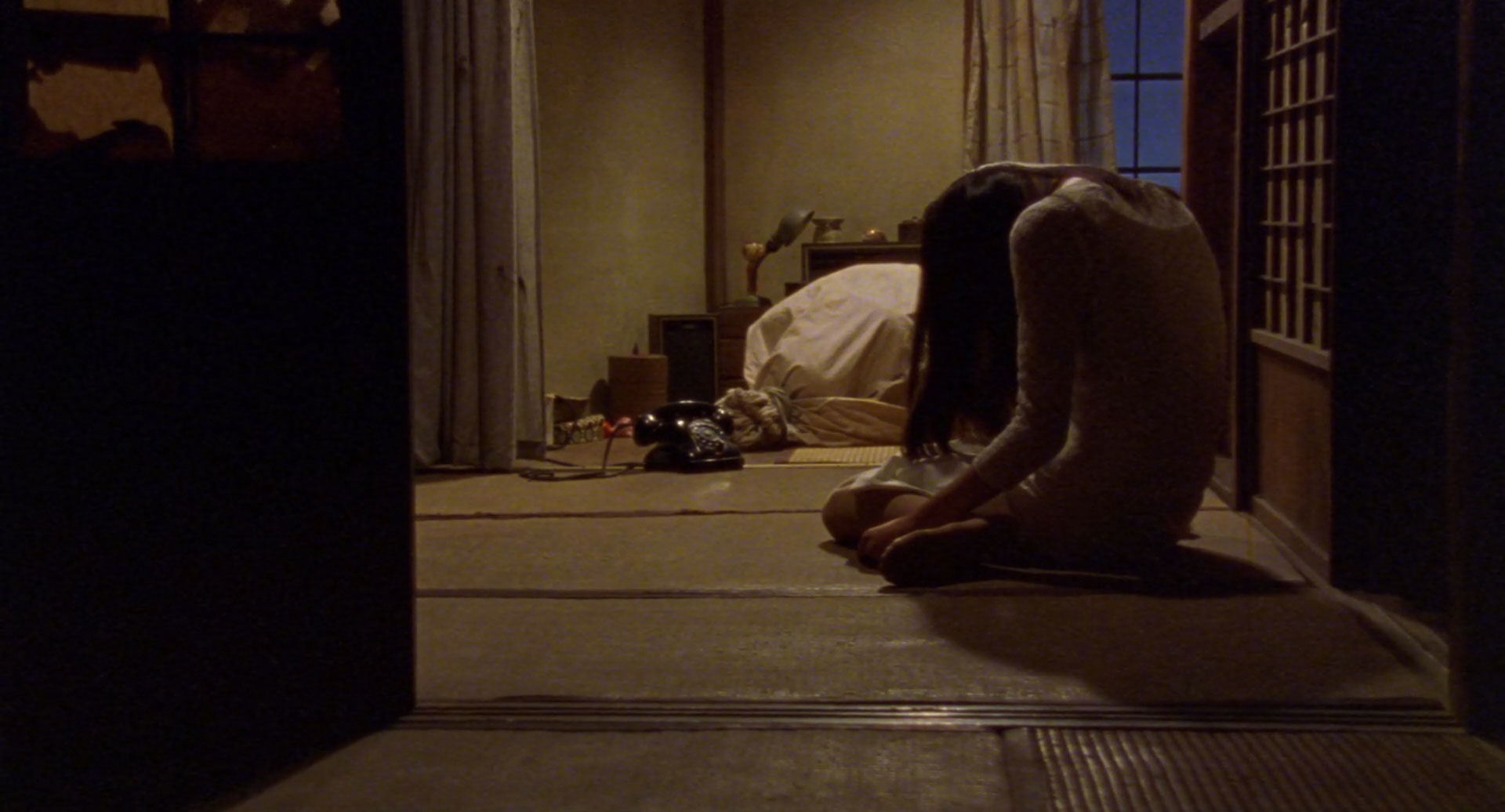
For much of the film, an empty apartment with a mysterious, groaning sack is the only giveaway that Audition is not gentle, romantic drama. Aoyama, a middle aged widower, is convinced by his film producer friend to hold fake auditions to find him a new wife. He picks a delicate ballerina named Asami (played by Eihi Shiina), and the plan starts off well enough. But there are signs that thins aren’t right; her references don’t check out, and we get glimpses of her strange home life – cue the sometimes moving sack. Things slowly start to fall off the rails, and we get glimpses of horror unfolding, but Miike does nothing to prepare us for the horror he has in store for the climax of the film. It’s this mix of a slightly unhinged romance, hypnotic scenes exploring memory and consciousness, and outright unbearable terror that solidifies Audition as an enduring classic, two and a half decades after its release.
In the muted glow of contemporary Tokyo, where grief clings like persistent fog, Takashi Miike’s Audition (1999) masquerades as a wry romantic comedy before erupting into a visceral J-horror landmark—a scabrous satire on male entitlement and the chasm between genders. Adapted from Ryu Murakami’s novel, it centers on Aoyama (Ryo Ishibashi), a widowed film producer in his forties, adrift in loneliness seven years after his wife’s death, his days a haze of editing reels and awkward silences with his perceptive teenage son, Shigehiko (Tetsu Sawaki). Shigehiko, grappling with his own veiled misogyny—flipping through swimsuit magazines with casual leers—urges his father to remarry, his protectiveness laced with the era’s casual objectification of women as nurturing ideals.
Enter Yoshikawa (Jun Kunimura), Aoyama’s sardonic colleague, who proposes a cynical ploy: stage a sham audition for a fictional widowhood drama to vet potential brides, sifting through hopefuls for youth, beauty, and docility. In a sterile room humming with fluorescent tension, Aoyama encounters Asami (Eihi Shiina), a lithe ex-ballerina in her twenties, her cropped hair and vacant smile evoking fragile porcelain—abandoned by a sadistic mentor who crippled her ambitions, now simmering in a limbo of temp jobs and unanswered calls. Her audition monologue, a haunting plea for connection, ensnares him: “I want to be the wind in the willows that sways at your window,” her affectless eyes hinting at coiled depths.
Miike lures us into this setup with languid elegance—rain-swept streets, sake-soaked dinners—building a psychological idyll rich in ironies, where Aoyama’s self-pity blooms into masochistic fixation. Yet beneath the rom-com facade festers a brutal critique: men’s oblivious predation, viewing women as interchangeable voids to fill, their traumas dismissed as footnotes. Asami, no passive ingénue but a demonic avenger forged in betrayal, inverts the power dynamic, her vengeance a furious howl against patriarchal arrogance—”the cure for male arrogance,” as one critic dubs it. Hallucinations bleed into reality, pins and saws symbolizing exorcised hostilities, transforming courtship into a nightmare of mutual isolation.
Audition transcends shock, dissecting social malaise through gender’s irreconcilable rifts. A stomach-turning masterpiece that lingers, questioning if love’s illusions breed only despair.
Cure – 1997
On Saturday the 1st of November we take you into the shadowy underbelly of late-1990s urban Japan, with Cure. The story unfolds as a hypnotic psychological thriller directed by Kiyoshi Kurosawa, blending crime procedural with existential dread. Detective Kenichi Takabe (Koji Yakusho), a weary cop grappling with his wife Fumie’s spiralling mental decline — marked by disorientation and eerie domestic rituals — investigates a rash of baffling murders. Each perpetrator, dazed and confessional yet utterly amnesiac about their motives, slashes an “X” into the victim’s neck, evoking ritualistic precision amid modern malaise.
The thread unraveling this nightmare leads Takabe to Mamiya (Masato Hagiwara), a enigmatic drifter and lapsed psychology student haunted by amnesia and an obsession with 19th-century mesmerism. Encounters with Mamiya, who disarmingly probes with the question “Who are you?”, seem to ignite latent aggression in ordinary souls, stripping away societal veneers of politeness to reveal a seething undercurrent of repressed rage. Aiding Takabe is psychiatrist Makoto Sakuma (Tsuyoshi Ujiki), who dissects the crimes through a lens of hypnosis and collective psyche, blurring lines between rational inquiry and supernatural contagion.
Kurosawa’s unhurried, clinical style – long takes, diffuse lighting, and humming ambient unease — prioritises atmospheric rot over tidy resolutions. Themes of identity erosion, societal sickness, and the “cure” as insidious projection permeate, diagnosing Japan’s polite facade as a breeding ground for nihilistic violence. As Takabe teeters on the edge, mirroring his wife’s fragility, Cure mesmerises, questioning whether evil is a virus or a whisper in the collective unconscious, A chilling landmark in J-horror that lingers like a half-remembered dream.
One Cut Of The Dead
On Sunday night we’re changing tracks and lightening the mood with one of the most inventive comedies of the last decade. In the gritty confines of an abandoned water purification plant (rumoured site of shadowy military experiments) a ragtag crew races against the clock to shoot a low-budget zombie flick in one unbroken take for a desperate TV broadcast. Director Higurashi (Takayuki Hamatsu), a mild-mannered hack turned tyrannical visionary with a mantra of “fast, cheap, but average,” barks orders at his beleaguered team, demanding raw authenticity amid exploding squibs and improvised gore.
Leading the undead onslaught are the film’s ingénues: the scream-queen Nao (Yuzuki Akiyama), whose relentless wails mask a budding actress’s frustration, and her co-lead Koji (Kazuaki Nagaya), a reluctant heartthrob pausing mid-bite for direction. Tough-as-nails makeup artist Chinatsu (Mio Kudo) stitches wounds—fake and otherwise—while Higurashi’s cinema-savvy daughter Mao navigates family tensions and production pitfalls.
But as shambling extras breach the barricades, blurring scripted chaos with visceral terror, the 37-minute opener erupts into a breathless frenzy of survival and slapstick. Shinichiro Ueda’s meta-masterpiece then rewinds, unveiling a nesting-doll narrative: the “zombie” assault as guerrilla ingenuity, transforming budgetary woes into triumphant reinvention. A joyous ode to DIY filmmaking’s scrappy soul, it skewers genre clichés while celebrating collaborative alchemy—frustration forged into farce, where every flub fuels the frame. Explosive diarrhoea, existential rants, and heartfelt hijinks propel this cult sensation, a zombie romp that devours expectations and spits out pure, unfiltered glee.